Why Chewy's YouTube Ads Get Liked Like TikTok Videos While Other Brands Get Ignored, and What Its 120 Creatives Reveal About the $158 Billion Pet Parent Economy
Why Chewy's YouTube Ads Get Liked Like TikTok Videos While Other Brands Get Ignored, and What Its 120 Creatives Reveal About the $158 Billion Pet Parent Economy
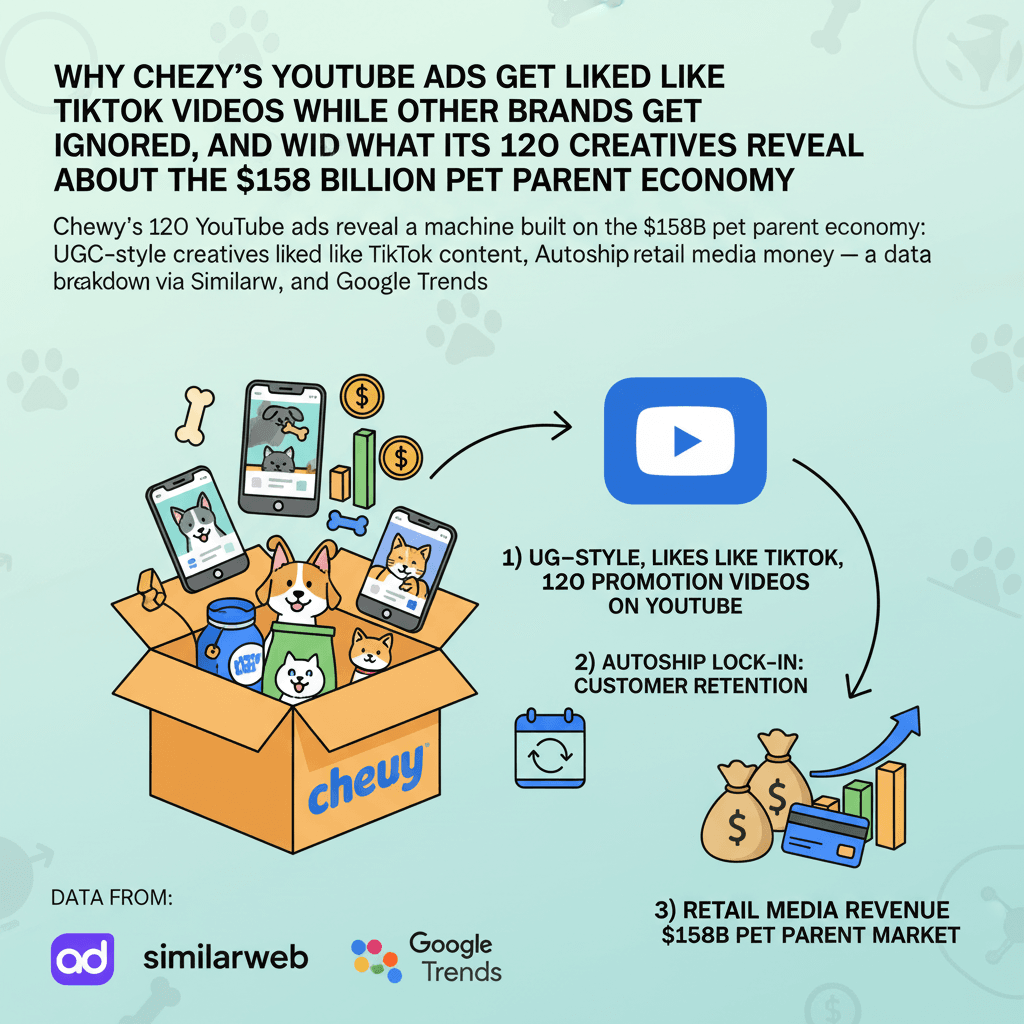
Chewy's 120 YouTube ads reveal a machine built on the $158B pet parent economy: UGC-style creatives liked like TikTok content, Autoship lock-in, and retail media money — a data breakdown via AdSee AI, Similarweb, and Google Trends.
TIna Percha18 Jul 2026analysis
Why Chewy's YouTube Ads Get Liked Like TikTok Videos While Other Brands Get Ignored, and What Its 120 Creatives Reveal About the $158 Billion Pet Parent Economy
Chewy's 120 YouTube ads reveal a machine built on the $158B pet parent economy: UGC-style creatives liked like TikTok content, Autoship lock-in, and retail media money — a data breakdown via AdSee AI, Similarweb, and Google Trends.
Twenty years ago, if you wanted to build a consumer empire, you built it on young parents. Diapers, strollers, baby monitors — the demographic with the deepest wallet and the most fear.
Millennials broke that playbook. They skipped the crib.
And bought the orthopedic dog bed instead.
Here's the market they built: $158 billion in US pet spending in 2025, headed for $165 billion in 2026, per APPA. 95 million American households — 71% of all homes — own a pet. Millennials are the largest cohort of pet owners at 30%. 97% of owners call their pet a family member. The average owner drops about $1,700 a year per pet, up $200 in a single year.
And my favorite stat, because it tells you everything about how this money behaves: one in three dog owners says they cut their OWN budget to protect their pet's budget. Read that again. This isn't discretionary spending. It's a fixed obligation — the same slot in the household P&L that kids' expenses used to occupy exclusively.
Pet parents are the new parents. And one company built its entire machine on that wave. Let me show you what Chewy's advertising actually looks like from the inside — because I went through their creatives in the AdSee AI YouTube ads library, and the portfolio is a masterclass in owning an audience.
Exhibit A: the ad people liked on purpose
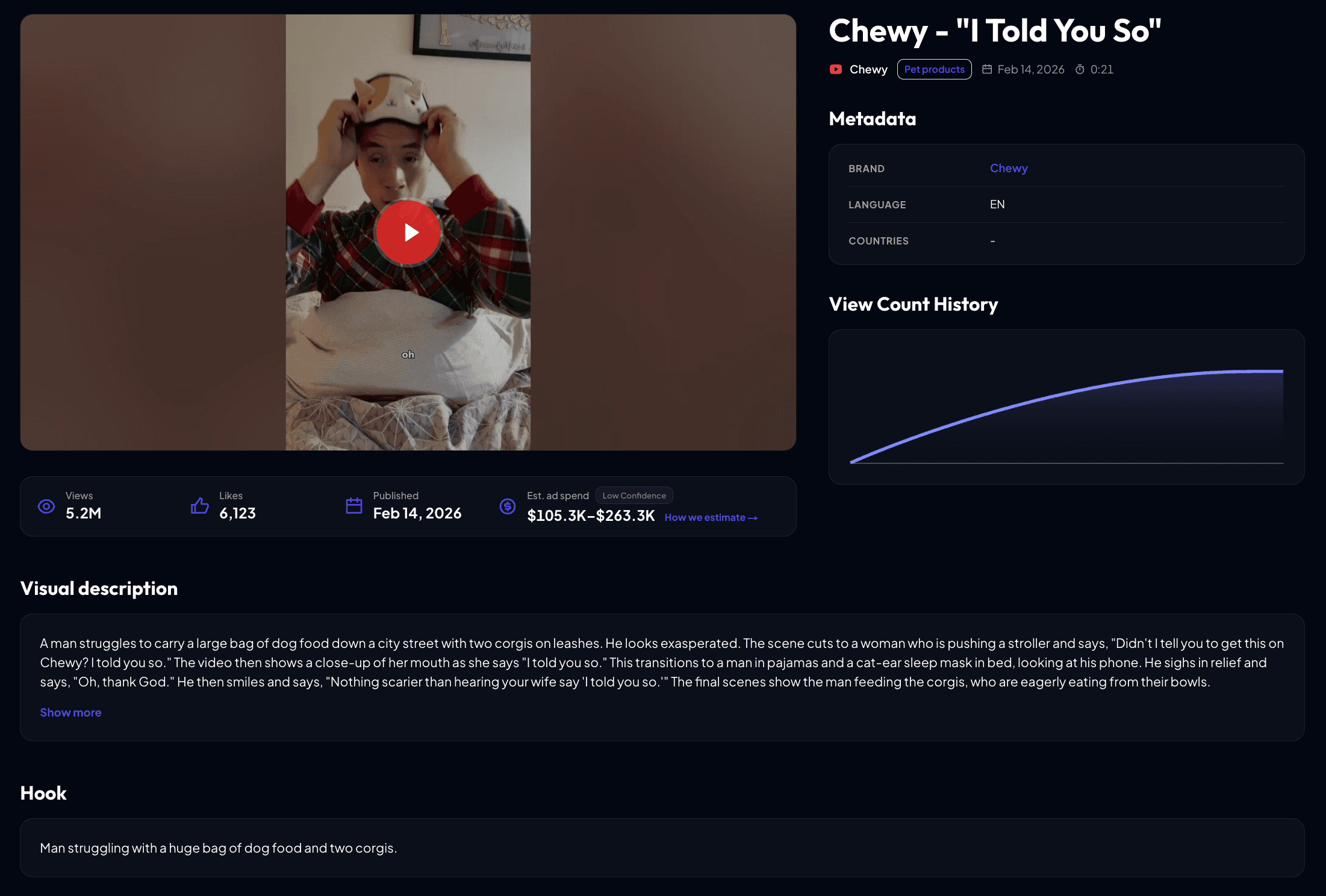
On February 14, 2026 — Valentine's Day, when every couple in America is on the couch watching relationship content — Chewy dropped a 21-second skit called "I Told You So." A husband struggles down the street with a giant bag of dog food and two corgis. His wife, pushing a stroller: "Didn't I tell you to get this on Chewy? I told you so." Cut to the same man waking up in bed in a cat-ear sleep mask, checking his phone in relief: "Nothing scarier than hearing your wife say 'I told you so.'"
The numbers, per AdSee AI: 5.2M views. 6,123 likes. That's one like per 849 views — on a paid ad.
For calibration: a soap brand's instream flight we analyzed this same quarter ran one like per 830,000 views. Chewy's skit out-engaged it by three orders of magnitude. The only other place we've seen paid media earn likes at this rate is native-styled mobile game ads (one per 82–365 views) — ads engineered to look like the content people already watch.
Which is exactly what this is. And it's not a one-off:
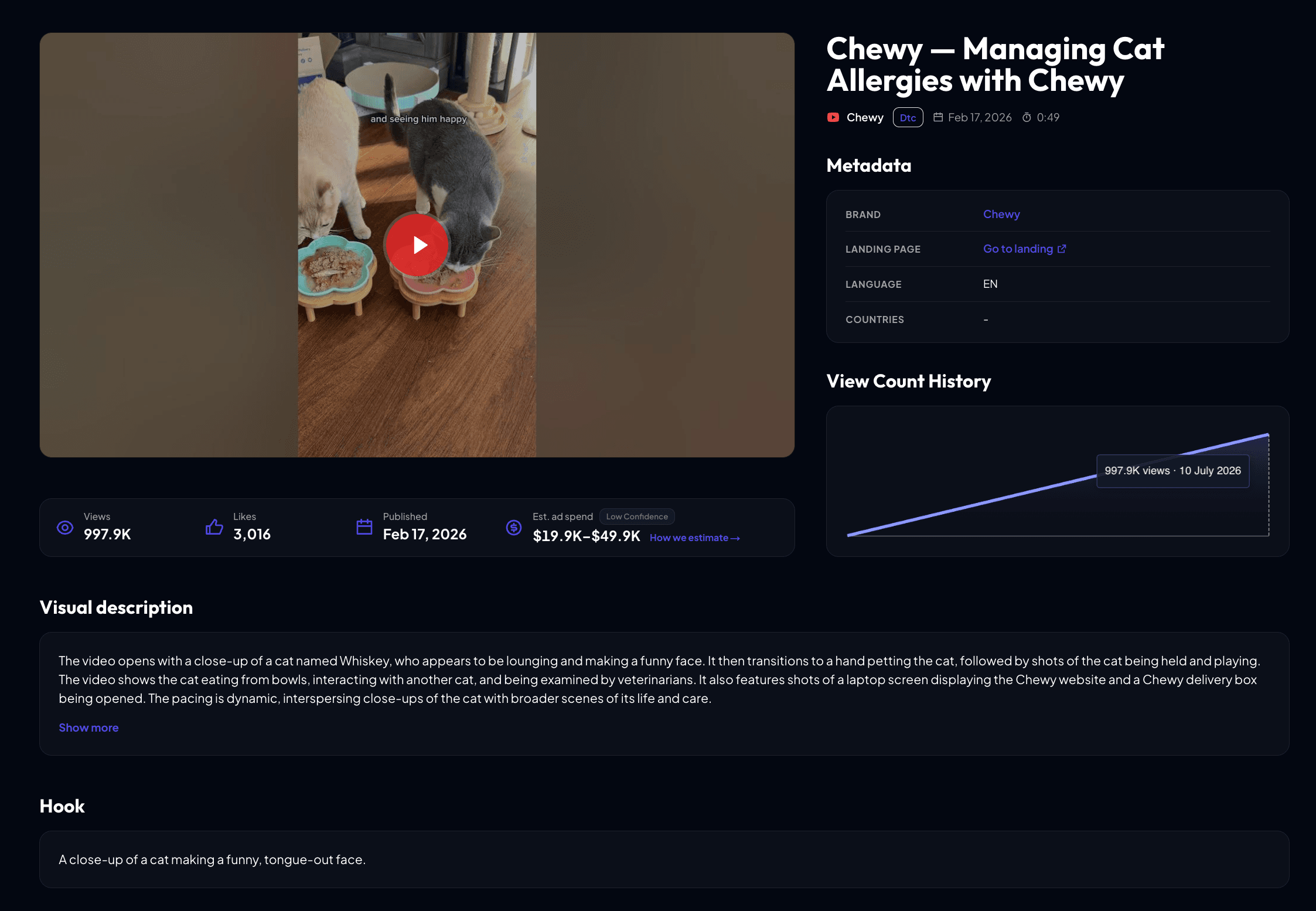
"Managing Cat Allergies with Chewy" (February 17, 49 seconds): a UGC-style story about a cat named Whiskey — funny faces, vet visits, a Chewy box on the doorstep. 997.9K views, 3,016 likes. One per 331 views, per AdSee AI, on a $19.9K–$49.9K budget.
"Sharing is Caring" (May 1, 52 seconds): two Borzoi dogs unboxing a Chewy delivery, shot like someone's phone video. 1.4M views, 1,366 likes — one per 1,025 — on $29.9K–$74.8K (high confidence).
These aren't commercials interrupting pet TikTok. They ARE pet TikTok, with a budget behind them. Chewy studied the mental habits of its audience — what they watch, save, and send each other at 11pm — and manufactured that, at five-figure costs per creative. The like counts are the receipt: people chose to watch ads for a pet food retailer.
Exhibit B: the polished engine running next to it
Now the twist. Chewy doesn't only do native. Per AdSee AI, the brand had 120 ads live in the period, and the portfolio splits into distinct machines.
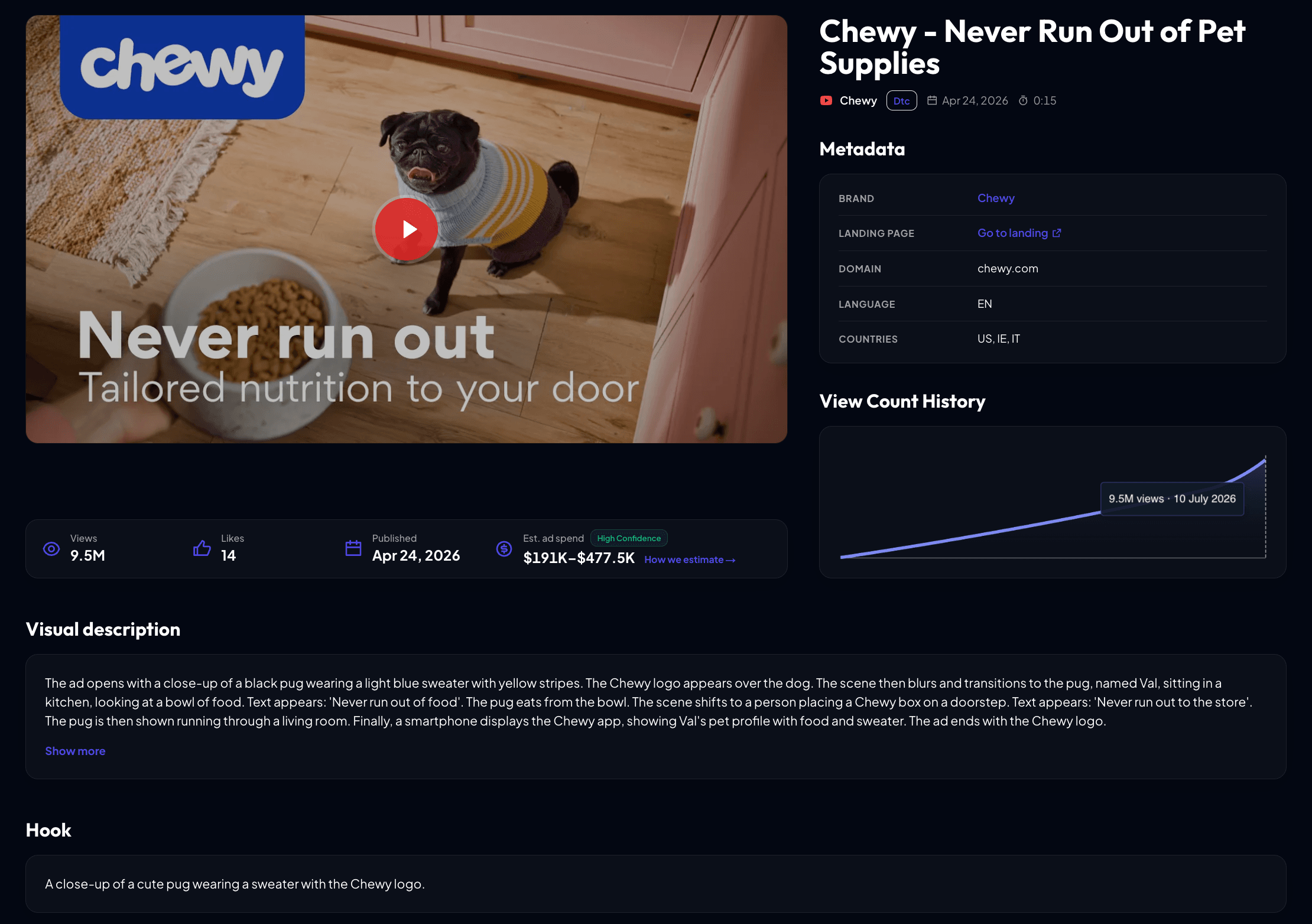
Machine two is the polished brand engine: "Never Run Out of Pet Supplies" (April 23) — a 15-second vertical spot starring a black pug named Val in a striped sweater. 9.55M views on an estimated $57.3K–$477.5K. Professional production, clean copy ("Never run out of food. Never run out to the store"), a proper CTA.
But watch the final frame: it's not the product. It's the Chewy app showing Val's pet profile — her food, her sweater size. The hero of the ad is the infrastructure. Remember that; we'll come back to it. (One more detail from the placement data: alongside the US, this creative ran in Ireland and Italy — small-market impressions worth watching from a company that has signaled international ambitions.)
Exhibit C: the till you didn't know existed
Machine three is the quiet one, and it's my favorite because it's pure ownership economics.
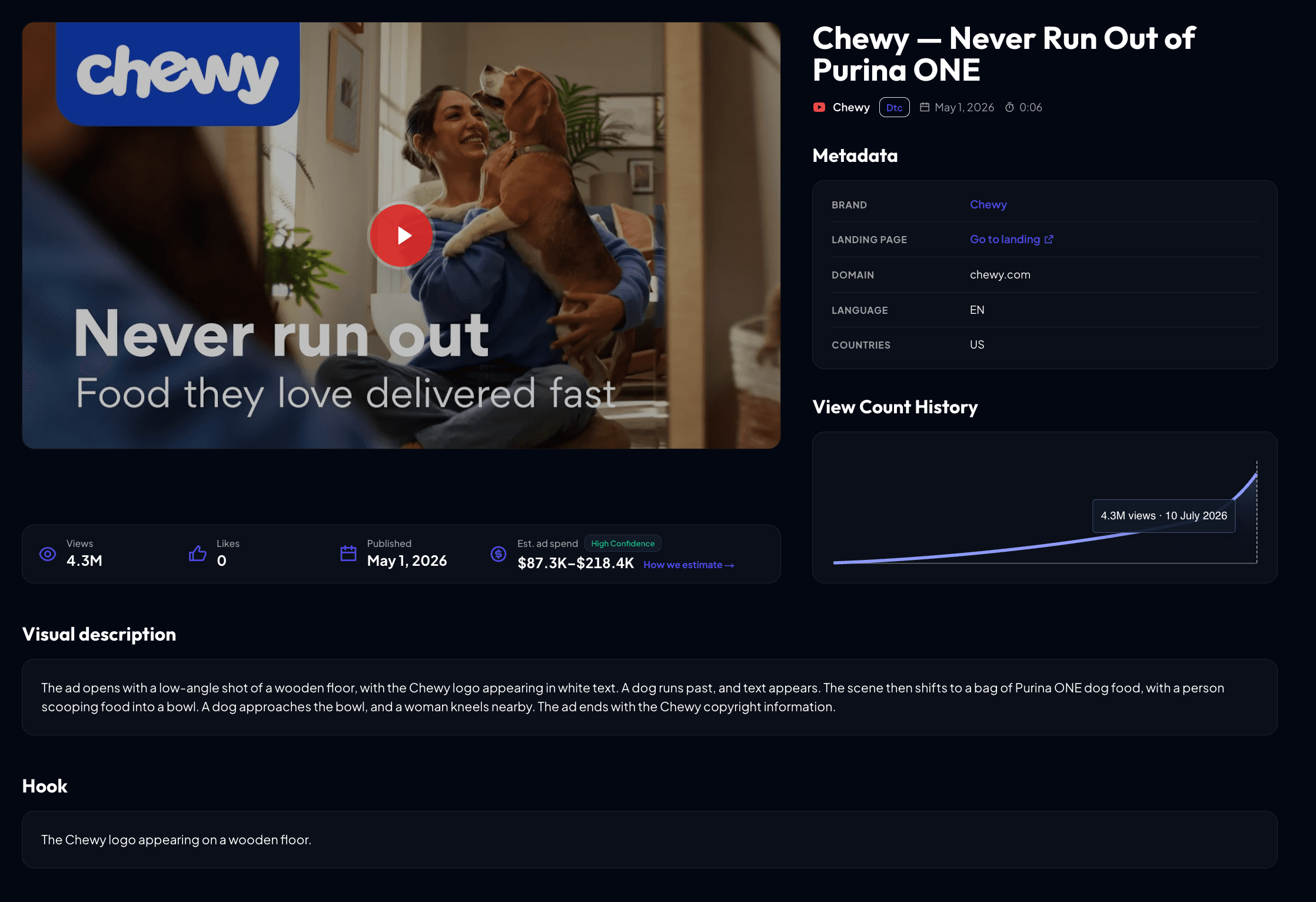
On May 1, Chewy published a 12-second ad for "Purina ONE Whole Body Support" — 7.4M views, $148.7K–$371.8K estimated spend, high confidence, per AdSee AI. Look closely: this isn't Chewy advertising Chewy. It's Chewy advertising a supplier's product, landing on Purina's brand page inside chewy.com.
That's retail media — the Amazon playbook. Once you own the audience, you don't just sell them products; you sell other brands access to them. As Sanchez writes in her NYT bestseller "Main Street Millionaire" (codiesanchez.com/book): "Your financial freedom can only come through ownership" — and what Chewy owns here isn't inventory, it's the audience itself. The ad dollars flow twice: once to acquire the pet parent, once from vendors paying to reach her. You will not find this second till in any press release. It's sitting in plain sight in the ad library, if you know to spy on YouTube ads the way investors read a balance sheet.
The machine underneath: why the audience can't leave
Here's what separates Chewy from a brand that just makes cute ads. The advertising fills a funnel that's built like a boring-business cash flow machine — the kind Codie Sanchez, who assembled a nine-figure portfolio of laundromats and car washes, has built a career on buying. Sanchez defines a Main Street business as the one you pay every month and barely notice: "not something new and innovative, they're continuous and compounding," as she put it on the Young and Profiting podcast (youngandprofiting.com/codie-sanchez-how-to-make-extraordinary-wealth-buying-boring-businesses-e319). Now look at what Chewy built — it's that model, digitized:
Autoship: subscription deliveries generating roughly 70% of net sales, per company disclosures. Recurring revenue on kibble. A laundromat would blush.
Connect with a Vet: free chat with licensed vet techs from 6 a.m. to midnight, $49.99 video consultations with veterinarians who can write prescriptions — filled, naturally, through Chewy. Over a million consultations, rated 4.9/5. When your vet is inside the store, the store becomes very hard to leave.
Pet profiles: Val's app profile from the ad isn't a cute touch. It's the data layer — breed, weight, diet, refill cadence — that makes every reorder frictionless and every recommendation personal.
Audience with money (the $158B wave). Content in their native format (the like rates). Infrastructure that locks them in (subscription + telehealth + profiles). Monetization on both sides (retail media). That's not a marketing strategy. That's a moat with a marketing department.
The scoreboard
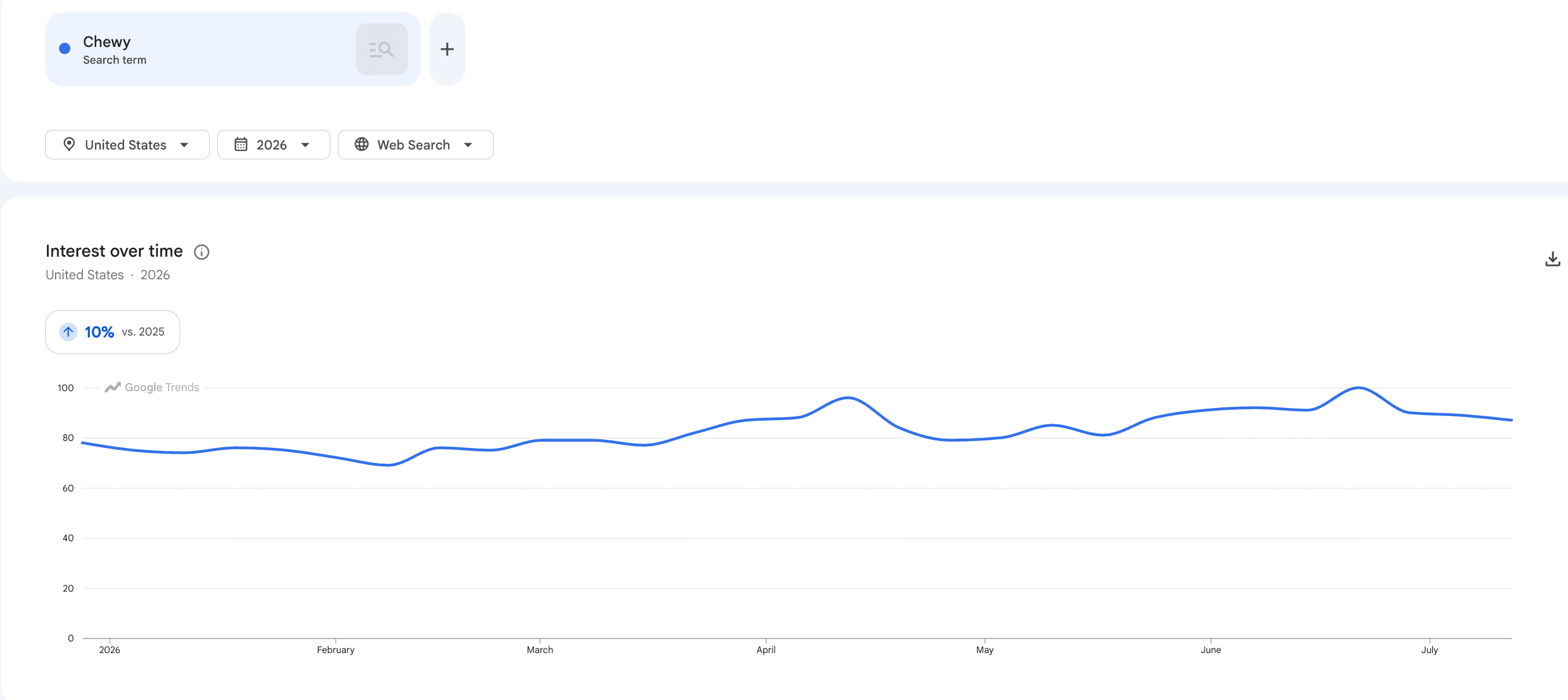
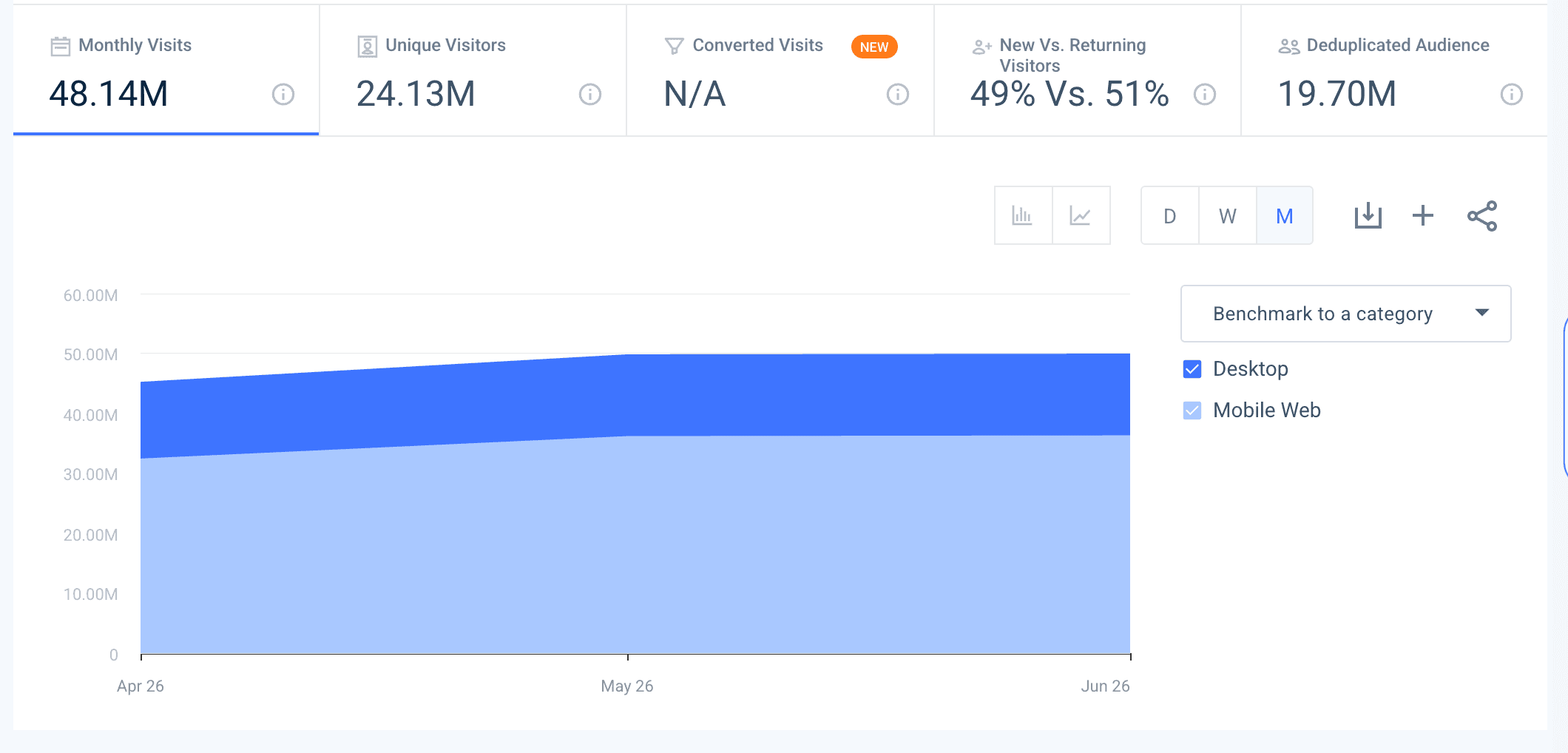
Does it show up in the big public numbers? Carefully, yes. Per Similarweb, chewy.com grew from 45M visits in April to 49.75M in June — +10.6% in a quarter, a rarity among the mature brands we've analyzed, where campaigns usually vanish into flat curves. Google Trends has Chewy search interest up 10% year over year, with peaks in mid-April and late June overlapping the spring flights. We won't claim clean attribution — 120 creatives, retail cycles, and seasonality all mix here — but the direction of every needle is up.
How we counted (methodology)
Sample: Chewy YouTube ad creatives identified in the AdSee AI YouTube ads library, Q2 2026 window with two February creatives included for the native-format analysis; 120 creatives live from the advertiser in the period. View and like counts from public YouTube counters as of the dates on each creative's view-count history (July 10, 2026 for most). Like rates computed as views divided by likes. Spend estimates are AdSee AI's, derived from views and country-level CPV benchmarks, shown as ranges with per-creative confidence levels. Website traffic: Similarweb, chewy.com, April–June 2026. Search interest: Google Trends, "Chewy", United States, 2026. Market data: APPA 2026 State of the Industry Report ($158B expenditures, ownership, and generational figures) and Morning Consult-based industry briefings (family-framing and budget-behavior stats). Company facts: Chewy disclosures and press materials (Autoship share, Connect with a Vet). Quotes — Codie Sanchez, "Main Street Millionaire" (Portfolio, 2024) and the Young and Profiting podcast, episode 319.
What to steal
Pick the wave before you pick the message. Chewy's real genius isn't creative; it's sitting on a $158B demographic shift where spending behaves like an obligation, not a choice. Find the audience whose wallet is structurally committed.
Make ads in your audience's native tongue. The like-to-view ratio is your lie detector: one like per few hundred views means people chose your ad; one per hundreds of thousands means they endured it. Chewy's UGC-style creatives cost five figures and out-engage seven-figure productions.
Advertise the lock-in, not just the product. The pug ad's final frame is an app profile, not a price tag. If you have infrastructure — subscriptions, service layers, data — that's your differentiator; kibble is a commodity.
Study competitors through their ad portfolio, not their press releases. Chewy's retail media business is invisible in its marketing blog and obvious in a YouTube ads spy tool: 120 creatives, three distinct machines, vendor money included. The media plan is the strategy, published in public.
FAQ
Why do Chewy's YouTube ads get so many likes compared to other brands? Because a large share of them are built as native pet content rather than commercials: per AdSee AI, Chewy's UGC-style creatives earn one like per 331–1,025 views — content-level engagement — while typical forced-instream brand campaigns run at one like per several hundred thousand views.
How many ads does Chewy run on YouTube? Per the AdSee AI YouTube ads library, Chewy had 120 creatives live in Q2 2026, spanning polished brand spots (9.55M views for the "Never Run Out" pug ad), native UGC-style skits, and retail media ads for supplier brands like Purina ONE.
Why are pet parents such a valuable marketing audience? US pet spending hit $158 billion in 2025 and is projected at $165 billion for 2026, per APPA; millennials are the largest owner cohort (30%), 97% of owners consider pets family, and one in three dog owners cuts their own budget before cutting their pet's — making pet spend behave like a fixed household obligation rather than discretionary purchases.
What is retail media and how does Chewy use it? Retail media is a retailer selling ad placements for supplier brands to its own audience. Per AdSee AI, Chewy's portfolio includes a 12-second Purina ONE ad (7.4M views, $148.7K–$371.8K estimated spend) landing on Purina's brand page inside chewy.com — the retailer monetizing its audience the way Amazon does.
Data and sources
Ad creatives, publish dates, view and like counts, creative counts, countries, landing pages, and spend estimates — the AdSee AI YouTube ads library. Website traffic — Similarweb (chewy.com). Search interest — Google Trends ("Chewy", US, 2026). Pet industry data — APPA 2026 State of the Industry Report; Morning Consult-based industry briefings. Company facts — Chewy press materials and disclosures (Autoship, Connect with a Vet). Quotes — Codie Sanchez, "Main Street Millionaire" (Portfolio, 2024) and the Young and Profiting podcast, episode 319.


 TIna Percha