How Coinbase Turned a $183K YouTube Budget Into the Smartest Fintech Campaign of the Year by Making the Prize Cost More Than the Ads
How Coinbase Turned a $183K YouTube Budget Into the Smartest Fintech Campaign of the Year by Making the Prize Cost More Than the Ads
Coinbase ran a single 15-sec YouTube Short offering a 5 Bitcoin prize to challenge its "Beat My Predictions" audience—prize worth more than the ~$183K ad spend.
Alex Hormozi14 Jul 2026analysis
How Coinbase Turned a $183K YouTube Budget Into the Smartest Fintech Campaign of the Year by Making the Prize Cost More Than the Ads
Coinbase ran a single 15-sec YouTube Short offering a 5 Bitcoin prize to challenge its "Beat My Predictions" audience—prize worth more than the ~$183K ad spend.
Most brands buy attention. Coinbase built an ad where the offer IS the attention.
Let me show you the math, because the math is the whole story.
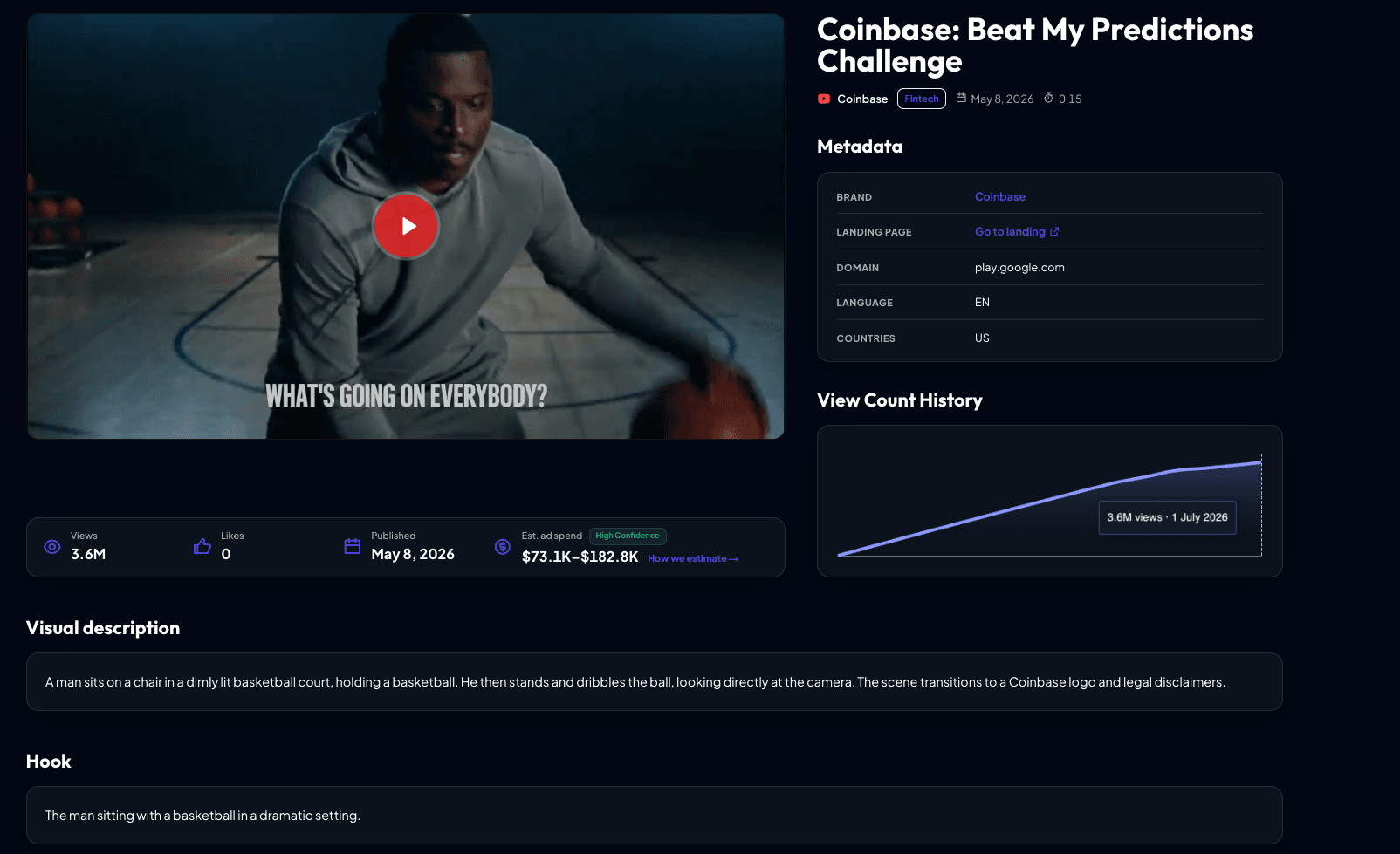
In May 2026, Coinbase dropped a 15-second vertical ad on YouTube. A man sits alone on a dark basketball court, ball in hand. He looks straight into the camera and throws down a challenge: beat my predictions, win a split of 5 Bitcoin, and get a chance to train with me.
That's it. Fifteen seconds. One offer.
By July: 3.66M views in the US. Estimated media spend: $73K–$183K, high confidence, per AdSee AI.
Now here's the part that should make every media buyer sit up.
The prize pool — 5 Bitcoin — is worth more than the entire media budget of the campaign. At any price Bitcoin has traded at recently, the giveaway costs multiples of what Coinbase paid YouTube to show it to you.
Read that again. They spent more on the prize than on the distribution.
Why the offer does the heavy lifting
Most fintech ads follow the same tired formula: trust signals, app screenshots, "sign up in minutes." Coinbase did the opposite. They took the media budget's job — earning attention — and handed it to the offer itself.
Here's what that buys you:
A challenge, not a pitch. "Beat my predictions" isn't a message you watch. It's a game you enter. Participation beats persuasion every time, because the viewer finishes the ad with something to DO.
A prize with a story. Cash is forgettable. "A split of 5 Bitcoin" is on-brand, quotable, and it makes the product — owning crypto — the reward. The prize IS the product trial.
A money-can't-buy layer. Training with the athlete in the ad is the component you can't price. That's what gets the campaign talked about beyond the paid impressions.
One creative, not a fleet
Here's what makes this campaign structurally unusual. AdSee AI's data shows Coinbase had 81 ads live in the same period — but the Beat My Predictions challenge ran as a single creative. One video, portrait format, 15 seconds, US-only.
Compare that to how big brands usually run flagship campaigns: a hero spot plus a fleet of cutdowns, localizations, and format variants. Coinbase inverted it. The brand's volume lives elsewhere in those 81 ads; the challenge got exactly one asset, built Shorts-native from the start.
And that's coherent with the offer logic. A challenge with a deadline and a single prize pool doesn't need twelve variants — it needs one unmissable piece of creative and enough frequency behind it. When the offer is strong enough, creative diversification is a tax, not a strategy.
The funnel you can't see
Now the second lesson, and honestly, it's the bigger one.
The ad doesn't send people to coinbase.com. It sends them to the Coinbase app listing on Google Play.
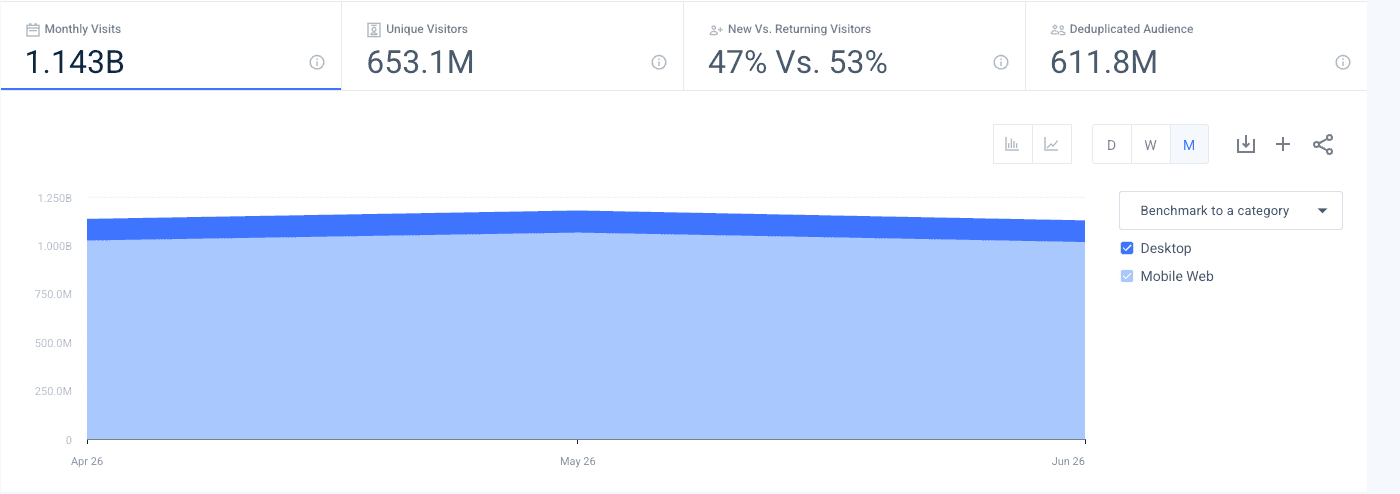
Go check the web analytics on that landing domain and here's what you get: play.google.com does 1.1B visits a month — 1.13B in April, 1.18B in May, 1.12B in June, with 653.1M unique visitors, according to Similarweb.
Those numbers tell you exactly nothing about this campaign. Coinbase's ad-driven installs are a rounding error inside Google Play's billion-visit ocean. The entire funnel — impression, view, install, signup — happens inside YouTube and the app store, and it never touches the open web.
This is what app-first fintech marketing looks like now. If your competitive research starts and ends with website traffic, campaigns like this are invisible to you. You'd swear Coinbase wasn't even running this play. Meanwhile they're giving away Bitcoin on national YouTube inventory.
How it counted (methodology)
Sample: Coinbase YouTube ad creatives published in Q2 2026, identified in the AdSee AI database by advertiser; the Beat My Predictions creative published May 8, 2026. View count from public YouTube counters as of early July 2026. Countries from placement data. Spend estimate: views × US CPV benchmarks, presented as a range; confidence is high because the campaign ran in a single market. Landing domain traffic: Similarweb, Monthly Visits. The 81-ad figure counts all creatives from the same advertiser live in the same period per AdSee AI.
The takeaway
Steal the structure, not the budget:
Make the offer do the work. If your prize, guarantee, or bonus isn't more interesting than your ad, fix the offer before you touch the targeting.
Match the format to the placement. 15 seconds, vertical, one CTA. Not a TV spot crammed into Shorts.
Track competitors where they actually spend. Web traffic misses app-install campaigns entirely. Creative-level ad intelligence — views, spend, formats, campaign counts — is the only window into this funnel.
Coinbase didn't outspend anyone here. $183K max is lunch money in fintech. They out-offered everyone. That's the difference between buying attention and earning it with the same dollars.
FAQ
How much did Coinbase spend on the Beat My Predictions ad?
According to AdSee AI's estimate, $73K–$183K with high confidence, against 3.66M views in the US as of early July 2026.
Why is the prize worth more than the media budget?
The prize pool is a split of 5 Bitcoin, which at recent prices is worth multiples of the $183K maximum spend estimate from AdSee AI. Coinbase shifted budget from distribution to the offer itself, letting the prize earn the attention.
Why doesn't the campaign show up in web analytics?
The ad's landing page is the Coinbase app listing on Google Play, and per Similarweb the play.google.com domain does around 1.1B visits a month — the campaign's installs are statistically invisible inside that volume. The funnel runs entirely through YouTube and the app store.
What format did the ad use?
A 15-second portrait (vertical) video built for YouTube Shorts placements, running US-only, published May 8, 2026, per AdSee AI.



 Alex Hormozi